
This article is published on behalf of ACM Coatings GmbH (subsidiary of Acktar Ltd.), a paying participant in the satsearch Trusted Supplier program.
The week of the 14th – 18th October 2024 was a special one for Acktar, as the company celebrated a couple of major contributions to some ground-breaking space missions.
On October 14 NASA successfully launched the Europa Clipper mission, which is to explore Jupiter’s moon Europa. On board the spacecraft was a powerful instrument called the Europa Thermal Emission Imaging System or E-THEMIS.
E-THEMIS has been designed to capture thermal infrared images of Europa’s surface, mapping temperature variations across the moon’s icy crust, and Acktar’s ultra-black coatings are playing an important role in ensuring the instrument’s accuracy.
Then, on 15 October the European Space Agency (ESA) Euclid Space Telescope team released the first batch of images from the hugely ambitious discovery mission, aiming to reveal the mysteries of dark matter and dark energy. This was in the form of a mosaic of imagery featuring tens of millions of stars in our galaxy, as well as approximately 14 million distant galaxies.
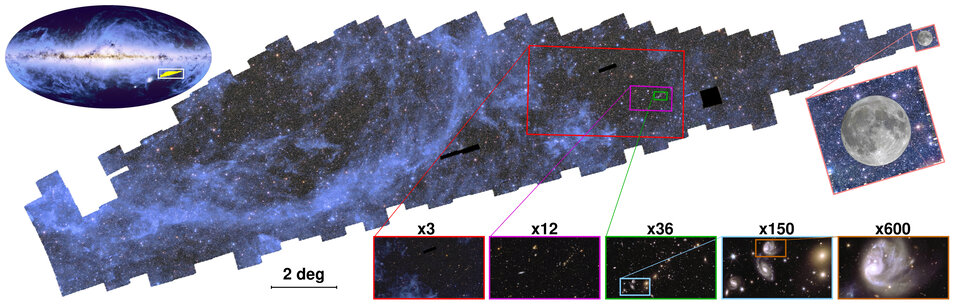
Mosaic of Euclid’s first images (credit: ESA).
Acktar’s Fractal Black coating is being used on Euclid’s Near Infrared Spectrometer & Photometer (NISP) instrument, which is capturing important spectroscopic data across huge areas of interest.
It was a very exciting and motivating week for Acktar, to see such important milestones in not one but two major missions. We share more about their role in these pioneering projects in the sections below.
Acktar’s involvement in the Europa Clipper mission: a step closer to discovering life?
The ambitious Europa Clipper mission could answer one of humanity’s most profound questions: is there life beyond Earth?
Jupiter’s moon Europa, with its suspected vast subsurface ocean beneath a thick ice crust, is considered to be one of the prime candidates in our solar system for harboring extraterrestrial life.
The Europa Clipper is equipped with an array of advanced scientific instruments to study the moon’s ice shell, subsurface ocean, and surface composition, and Acktar is proud to play a key role in this important mission, and specifically in the E-THEMIS instrument
The role of E-THEMIS on the Europa Clipper
The Europa Thermal Emission Imaging System (E-THEMIS) was developed by the University of Arizona. It is tasked with capturing thermal infrared images of Europa’s surface, mapping the temperature variations across the moon’s icy crust.
These thermal maps are essential for detecting potential “hotspots” where heat is rising from below the ice, possibly indicating areas of geological activity or thinner regions of ice, where the subsurface ocean might be interacting with the surface.
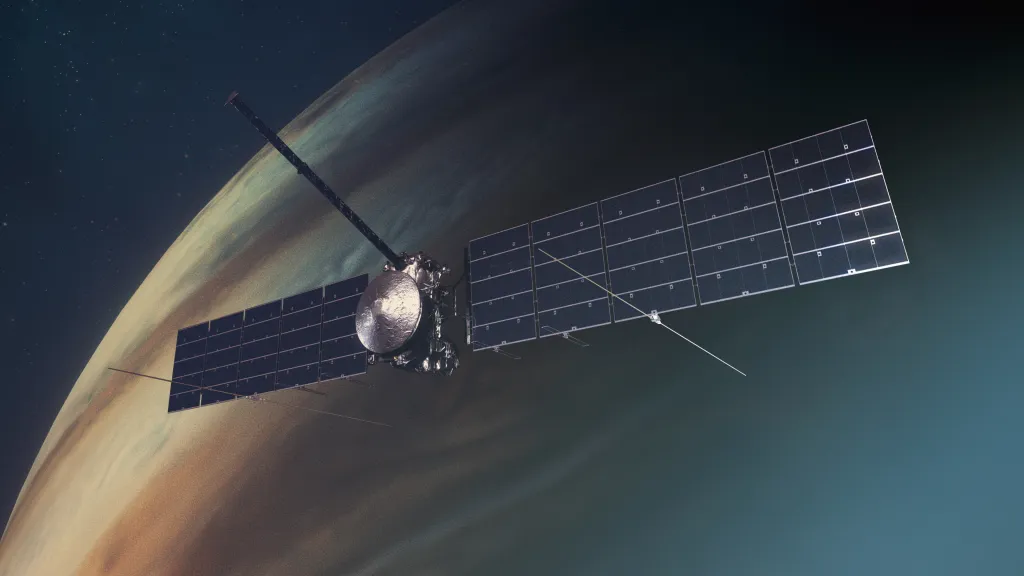
Render of the Europa Clipper spacecraft (credit: NASA).
By identifying warmer areas E-THEMIS will help pinpoint locations where the ice should be thinner, providing insights into the dynamics of the ocean underneath. These areas are likely to be prime targets for future missions or landers, as they may offer the best chances of accessing the ocean, making E-THEMIS crucial for understanding Europa’s potential habitability.
Why far-Infrared for E-THEMIS?
Far-infrared radiation is key to detecting heat and temperature differences on Europa’s surface. This wavelength range is perfect for sensing thermal emissions that indicate warmer regions under the icy crust.
Unlike other wavelengths, far-infrared can penetrate deep into the surface, allowing scientists to detect variations in the thickness of the ice, potentially revealing areas where water is closer to the surface.
It also helps in identifying active geological processes, such as plumes or geysers, which could offer clues to the interaction between Europa’s ocean and its surface. Understanding these dynamics is critical in assessing Europa’s ability to support life.
Acktar’s contribution to the E-THEMIS instrument
Acktar’s ultra-black coatings are playing a vital role in ensuring the precision and effectiveness of E-THEMIS. They are applied to critical parts of the instrument to absorb straylight and minimize reflections in the whole IR band, from NIR to FIR (far infrared), allowing the far-infrared detectors to focus solely on capturing the faint thermal emissions from Europa’s surface.
Even small amounts of reflected light could distort the readings, which is why Acktar’s coatings are essential to the mission. By eliminating these interferences, the instrument can capture the most accurate thermal data possible, enhancing the chances of discovering key features that could lead to the detection of life-supporting environments.
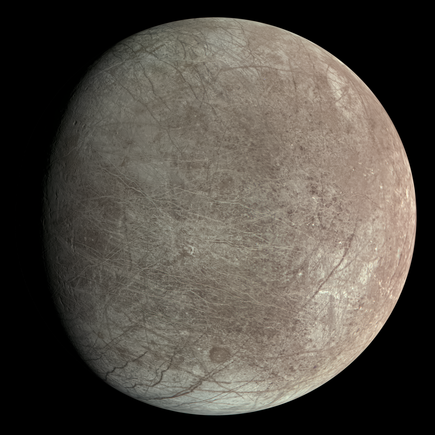
Europa, one of the 4 ‘Galilean moons’ that orbits Jupiter (credit: Wikipedia).
Acktar’s broader involvement in the exploration of Europa
This isn’t Acktar’s first contribution to Europa’s exploration. Previously, the company was involved in ESA’s JUICE mission (Jupiter Icy Moons Explorer) launched in April 2023. JUICE is set to study Europa alongside the other moons of Jupiter, such as Ganymede and Callisto.
The commemorative plaque
In many space missions there is a longstanding tradition of creating commemorative plaques. For Europa Clipper, Acktar was asked by the University of Arizona to sign on paper, which was later engraved onto a plaque.
One copy of this plaque was launched with the spacecraft, symbolizing the contribution of all key partners to the mission. After the successful launch, a second copy of the plaque will be sent back to Acktar as a recognition of the company’s vital role in the mission.
This tradition is deeply rooted in the space community, where plaques are created to honor the collaboration of all contributors. These plaques not only celebrate teamwork but also serve as lasting reminders of each team’s involvement.
For NASA and other space agencies, plaques from significant missions are often displayed at mission control centers, research facilities, or museums. Some are even left in space, like the famous plaques left on the moon by the Apollo missions.

The Apollo 11 plaque, on the Lunar Module Eagle on the Moon, including the signatures of the mission team along with U.S. President Richard M. Nixon (credit: Wikipedia).
For Acktar, receiving a copy of the Europa Clipper plaque after the launch is a hugely exciting milestone, giving the team a tangible connection to a spacecraft now traveling millions of kilometers from Earth.
Acktar in the Euclid mission
The Euclid mission is a 6 year project designed to study the nature of our universe from Sun-Earth Lagrange point 2.
The spacecraft, comprised of a service module and payload module with 2 different analysis instruments, is capable of observing the Universe’s evolution spanning the last 10 billion years.
By observing the dynamics of the Universe’s expansion and the emergence of cosmic structures through history, the Euclid team aim to improve our understanding of fundamental questions on topics such as:
- The nature of dark energy
- The characteristics of dark matter
- How the universe has expanded over time
- The nature of gravity itself
The role of the NISP on Euclid
The Near Infrared Spectrometer & Photometer (NISP) instrument is one of two main observational technologies onboard Euclid. The others are a powerful visual telescope and a visual imager.
It is made up of 16 Teledyne “H2RG” detectors, each with a resolution of 2,000 x 2,000 pixels, for approximately 64 million pixels in total.
The NISP will cover the same field-of-view (FoV) as the visual imager onboard Euclid, but will instead capture data in the near-infrared (NIR) part of the spectrum, with wavelengths between ~950 nm and 2020 nm.
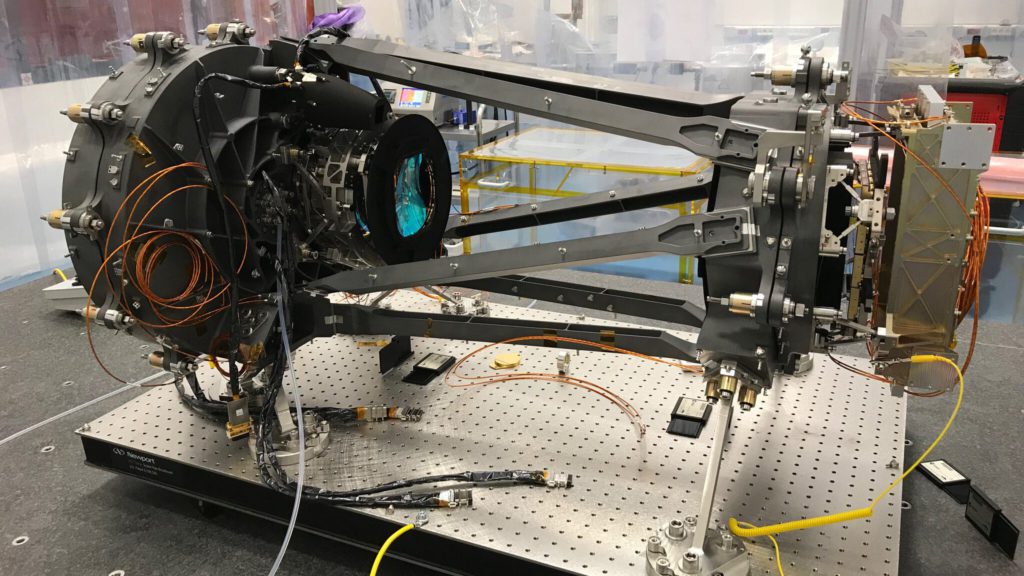
The NISP instrument prior to integration into the spacecraft (credit: NISP team/LAM – Euclid Consortium).
The importance of near-infrared analysis to Universal observations
NIR data will complement visual data captured by Euclid (i.e. high-resolution images) with spectral information about the same region of interest.
In the Euclid Wide Survey the NISP will collect data from an area comparable to what the Hubble Space Telescope covered during its entire 30+ year lifetime.
Acktar’s contribution to NISP
Acktar’s Fractal Black coatings have been applied to both molybdenum and titanium substrates on surfaces in the NISP to improve precision and productivity.
The coatings absorb infrared light in unwanted wavelengths. The Camera Lens Assembly (CaLA) of the system was fitted with a baffle to reduce straylight, and it is the baffle surfaces that were coated by Acktar, with space-grade and qualified Fractal Black.
The Euclid spacecraft is undergoing a hugely ambitious mission aiming to unravel deep mysteries of cosmology and fundamental physics. This will only be achieved with accurate data collection, in large quantities, and Acktar is proud to play a role in this activity.
Building a deeper heritage
Acktar is very pleased to celebrate these two recent mission successes and is proud of its contributions to space science.
Europe Clipper and Euclid form just a part of Acktar’s rich heritage of contributions to important discover missions, joining others such as the James Webb Space Telescope (JWST) and BepiColombo mission. Take a look at more information about Acktar’s heritage in the video below.
To find out more about Acktar, please visit their satsearch supplier hub here.