
This article provides insights into how Austria-based satellite propulsion company ENPULSION ensures equipment availability, reliability, and performance through a robust supply chain management strategy.
It was developed in collaboration with ENPULSION, a paying participant in the satsearch Trusted Supplier program.
With more than 200 propulsion systems in space, and a cumulative on-orbit time of over 400 years, Field Emission Electric Propulsion (FEEP) technology has become one of the most mature and robust space propulsion technologies in the industry. In the first quarter of 2024 ENPULSION, a leading provider of FEEP propulsion systems, has doubled the capacity of its serial production to meet the increasing demand for short and reliable lead times.
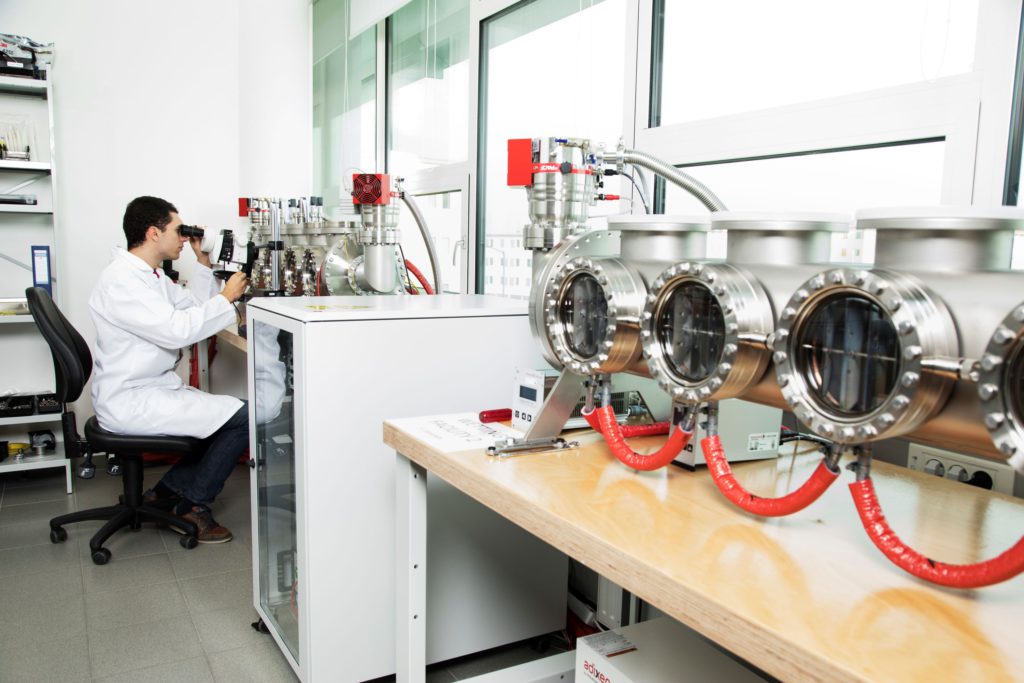
In recent years FEEP propulsion systems have been used for a wide range of different applications and use cases. ENPULSION has utilized its extensive heritage and experience gained to develop and improve a new generation of propulsion systems. In parallel the company has matured and expanded its production capabilities, and today operates an active serial production process, as well as an ISO-certified quality management system, with the goal to further advance its position as the most dependable provider of in-space mobility solutions in the market.
FEEP technology – helping satellite manufacturers save time and costs
FEEP propulsion generates thrust by electrostatic acceleration of metal ions. Ionization is achieved from a liquid propellant applying high electrostatic fields between the metal propellant and an extractor electrode. In ENPULSION’s FEEP systems, the metal indium, which is solid at room temperature during assembly, integration, and testing (AIT), as well as during launch, is liquified once in space and used as metal propellant. This brings many advantages for in-space mobility.
FEEP has the highest total impulse per volume and per wet mass compared to other electric propulsion technologies, due to the very high density of indium, when compared to propellants such as argon, krypton, xenon, or iodine. This makes FEEP systems very compact.
Since propellant liquification is only done once in space and for ground vacuum testing, the FEEP system is fully solid and inert during ground handling, integration, and launch. Emitted propellant is replaced in a fully passive manner by capillary forces (relying solely on surface tension of the propellant itself), which maintain propellant supply from the reservoir up to the emitter tips. FEEP thrusters therefore do not require any external forces from equipment such as pressurization systems or pumps. Even at the end of a mission, the system does not need to be passified, as it is self passivating.
For AIT and launch this also comes with additional advantages. FEEP propulsion systems are fully integrated and contain the tank as well as the propellant. Systems are shipped full and no additional filling operations at the satellite manufacturer’s facilities or launch sites are required. No part of the propulsion system is pressurized, and since the indium propellant is non-toxic, non-reactive, and non-radioactive, there is no need for additional safety requirements, which leads to tremendous cost and time-savings for satellite manufacturers.
FEEP advantages
- No pressurized components
- No additional safety requirements
- No filling operations
- No hazardous, reactive, or radioactive materials
- No additional launch requirements
FEEP heritage and use cases
FEEP technology has been used in space for a wide range of use cases and applications, and it offers some unique advantages to satellite manufacturers. ENPULSION’s FEEP propulsion systems have successfully been used for:
- Constellation deployment,
- Station-keeping,
- Orbit-raising,
- Orbit phasing and Ground Track Improvement,
- Formation flying,
- Collision avoidance,
- Drag compensation,
- Small GEO demo missions,
- Commercial BIU missions, and
- Several units in space are foreseen to perform de-orbit maneuvers once the first operational missions are over.

A new generation of FEEP products
Based on experience proven in many iterations of testing, production, and on orbit performance, gained on the heritage ENPULSION NANO thruster first used for in-orbit verification (IOV) in 2018, several successor propulsion models – the ENPULSION R³ systems – have been developed.
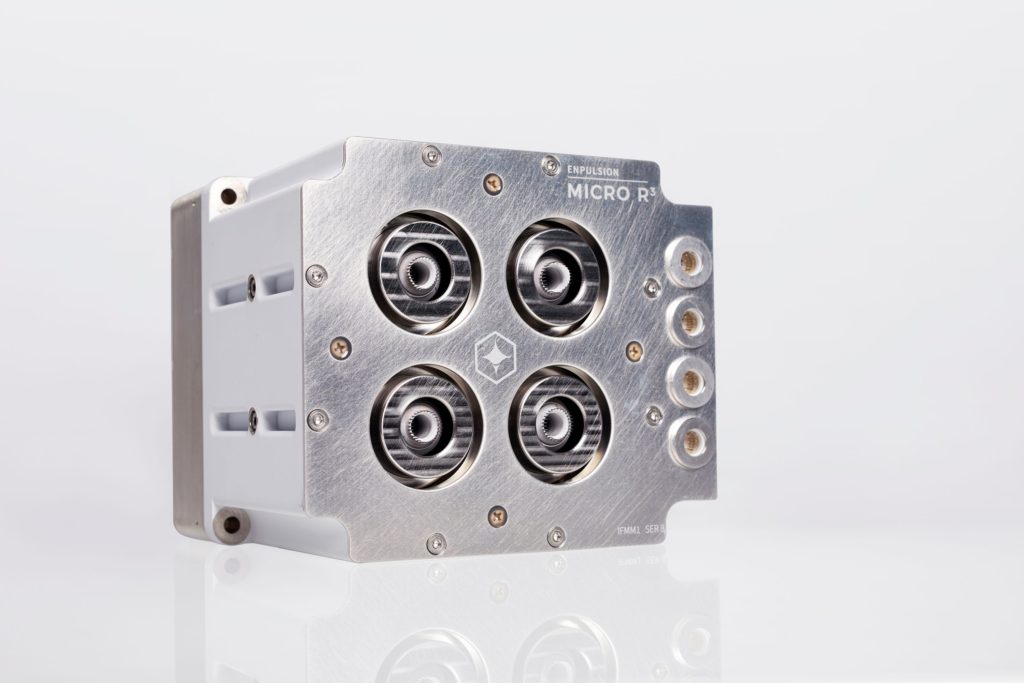
The ENPULSION NANO R³ is an updated version of the ENPULSION NANO featuring, among other improvements, higher radiation-tolerant electronics and an improved mechanical design to simplify integration. The ENPULSION NANO AR³ introduces thrust vector control without movable parts, and the higher power ENPULSION MICRO R³ expands the thrust range beyond 1mN.
All of these new propulsion systems have successfully achieved flight heritage and, at the time of publishing, over 200 FEEP propulsion systems have been launched. While the majority of FEEP systems on orbit continue to comprise of heritage ENPULSION NANO propulsion systems, which remain in use at a high launch cadence, these flight statistics also reflects the successful introduction of the successor products, ENPULSION NANO R³/AR³ and ENPULSION MICRO R³, which are being deployed in increased numbers.
You can find out more details on ENPULSION’s portfolio using the links below:

While the required power to operate the ENPULSION NANO starts at around 10 W, at higher thrust levels one can choose between high thrust and high specific impulse operation. The ENPULSION NANO can operate at at an Isp range of 2,000 to 6,000 s.
 Request quote
  request info
While the required power to operate the ENPULSION NANO R³ starts at around 8 W, at higher power levels one can choose between high thrust and high specific impulse operation. The ENPULSION NANO R³ can operate at an Isp range of 2,000 to 6,000 s.

The ENPULSION Nano AR³ uses differential emission throttling within the proprietary crown ion emitter to control actively the emitted ion beam and, therefore, thrust.

Building on the heritage of the ENPULSION NANO, ENPULSION has developed a scaled version of the technology to target small and medium size spacecrafts. The ENPULSION MICRO R³ is engineered in a modular approach, with units clustering easily together to form building blocks.
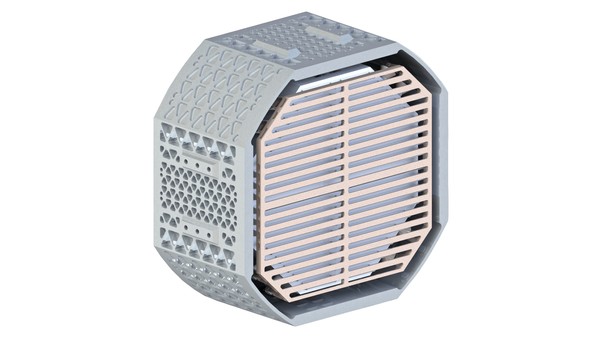
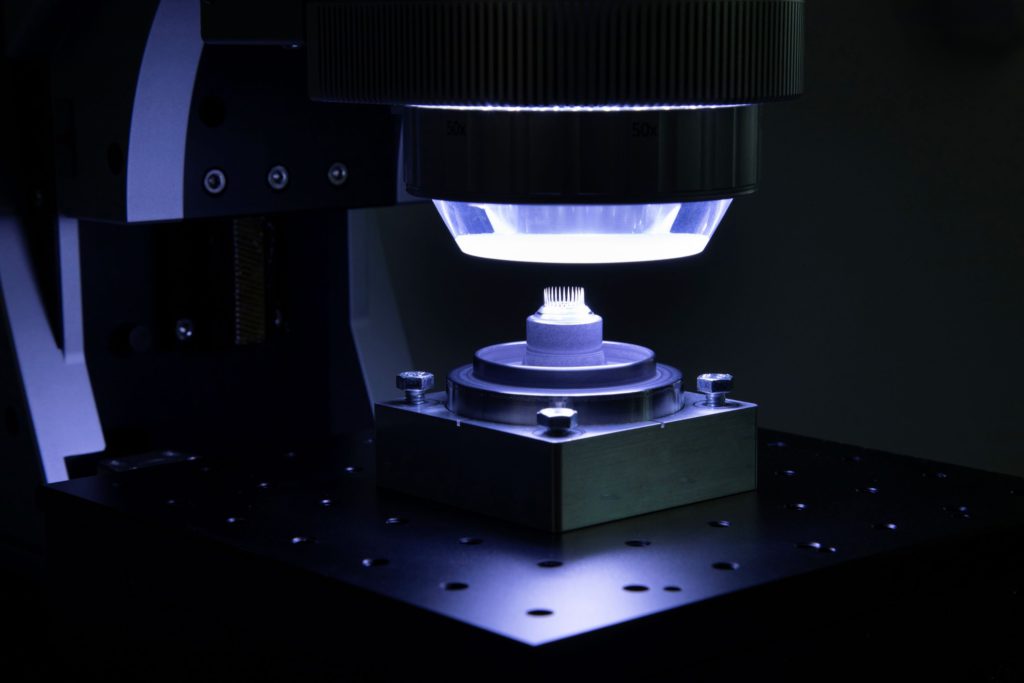
The ENPULSION NEO thruster is the next step in the FEEP technology evolution. By stepping up the number of ion emission sites by an order of magnitude compared to previous electrospray thrusters it allows high power and high thrust operation. The ENPULSION NEO thruster carries over the simplicity, ease of integration, and unmatched impulse density of ENPULSION’s products. Development and qualification of the ENPULSION NEO thruster is supported by the European Space Agency through the ARTES program. Qualification of the thruster system is scheduled to start in early 2025.

The ENPULSION Thruster Simulator Suite consists of hardware and software products that offer satellite manufacturers and satellite operators testing capabilities for ENPULSION thrusters and satellite hardware, including thermal and load simulation, error injection, and telemetry replay – across all program phases from initial concepts and design phases to technology development, operation all the way to end of mission.

The ENPULSION FEEP Workshop is conducted with an engineering unit of an ENPULSION propulsion system placed in a small-sized vacuum chamber. The setup allows for maximum flexibility by operating the thruster both using the ENPULSION EGSE GUI as well as operating the thruster using customer-furnished equipment, including OBC and EDU that can be placed table-top in air next to the vacuum chamber.
Industrial capabilities and short and reliable lead times
With the experience gained, ENPULSION has greatly increased the size of its production facilities in 2024 and doubled its production capacity. The company has an active serial production system currently shipping up to five propulsion units per week, which allows it to offer very short and dependable lead times.
ENPULSION has implemented an ISO-certified lean manufacturing process, and its meticulous planning and execution occur at every stage of the manufacturing process, spanning from assembly and integration to acceptance testing and continuous improvement, to ensure the best possible product outcome.
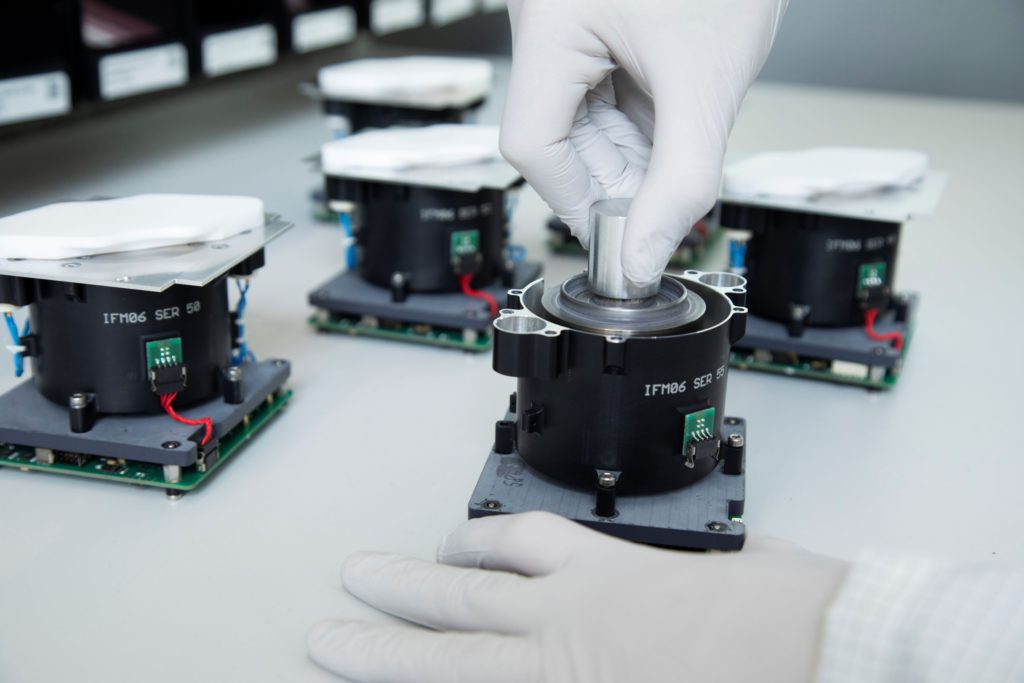
Capacity increase of 100%
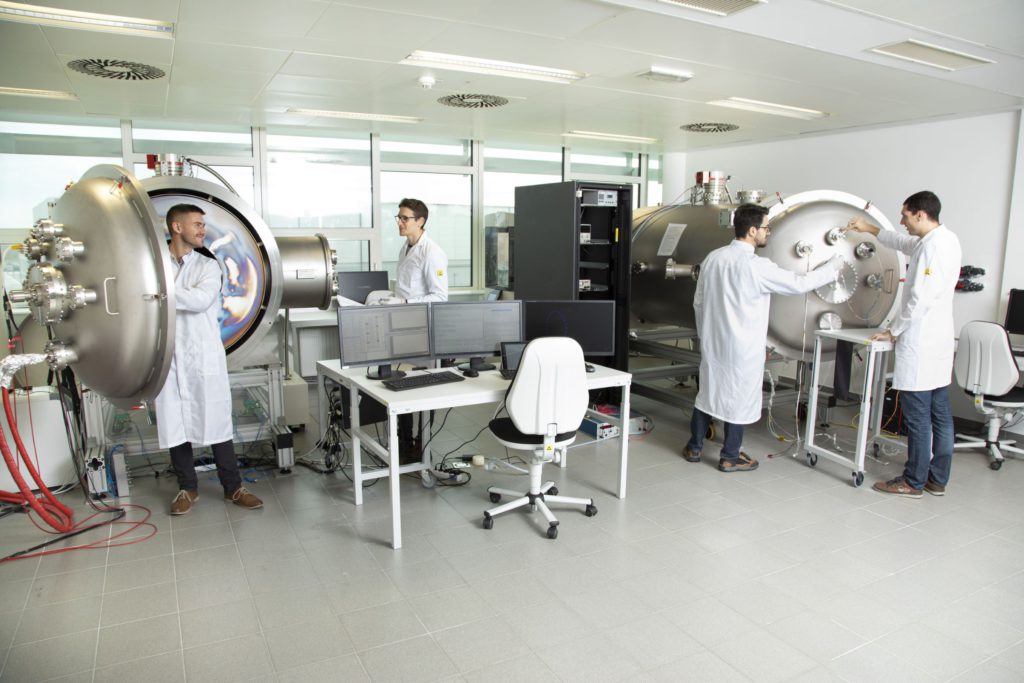
With ENPULSION’s new 4,000 sqm (43,000 sqft) facilities the company has doubled its capacity in emitter manufacturing, and has additional space to increase its whole manufacturing capacity by 100%. For increased flexibility, further capacities in R&D, with 6 additional vacuum chambers, can be shifted for final performance testing.
The company has taken additional actions to further increase capacity (vacuum chambers and several other long lead-time items are already ordered). ENPULSION’s 150 sqm (1,600 sqft) clean room is also prepared for an additional 100% capacity increase – an industry-leading capability.
De-risking of production planning – a 2 year stock of active components
In an increased effort to de-risk its production planning, ENPULSION has put all long lead-time items in stock and keeps a stock of active components for the next 2 years (with all radiation tests fully done).
It has also built additional stock in the size of 1 year of attrition – with rolling forecasts and orders every quarter.
Sustainable and dependable relationships
The focus of ENPULSION’s efforts is to further advance its position as the most dependable provider of in-space mobility solutions in the market. This includes providing the most efficient and reliable electric propulsion systems, by making full use of the company’s upgraded industrial capabilities, as well as offering short and reliable lead times.
ENPULSION is also building long-term, sustainable, and dependable business relationships with partners, satellite manufacturers, and operators.
Combined, these activities are enabling the sustainable use of orbital resources and innovative business models for a thriving near-earth economy.
To find out more about ENPULSION, please view their supplier hub here on the satsearch platform.